Posts mit dem Label Europe werden angezeigt. Alle Posts anzeigen

22.11.2016

Four more years “in search of lost time” for Europe? “Madame Alternativlos” and her eurozone austerity disaster

Angela Merkel was sworn into office as German Chancellor for the first time on precisely this date, November 22nd, in 2005, eleven years ago. On Sunday (November 20th) she announced her candidacy at the next parliamentary elections in Germany, well ahead of her initial intention to wait until January. The election is due to take place in approximately ten months from now, most likely in late September or early October, 2017. The current “political climate“ in Germany seems to be that there is no alternative to her continuing on after the next election. Yet, there is.


Chancellor Merkel (July 2010), here pictured with hands folded in a diamond shape, a
gesture which  has widely been interpreted as her signature hand gesture, or
the signature hand gesture of her "there is no alternative" attitude
.
Source: Wikimedia Commons

Just three days prior to that, at Thursday's (November 17
th) press conference with US president, Barack Obama, in Berlin, at the occasion of Obama's last state visit to Germany, she had evaded clear answers to questions about her own future beyond 2017 and had urged everyone to wait until the beginning of the election year itself. A couple of minutes later, she also stated „Demokratie lebt vom Wechsel - democracy is kept alive by change“. This was, of course, in reference to the current transition from the incumbent president Obama to president-elect Trump in the U.S., but it could also have been a hint at her own future. Yet, in hindsight, and in line with the decision she announced just a few days later, it turned out not to be, or in other words, to merely be a diplomatic phrase. The current “political climate“ in Germany seems to be that there is no alternative to Merkel (aged 62) continuing on after the next election, thus extending her tenure to over twelve years, and to fifteen years if she would stay on for the entire next four-year term. Thus she would, in late 2019, be overtaking the famous first post-war Chancellor Konrad Adenauer (fourteen years, 1949-1963) and, at the end of the said term, in 2021, be just short of the sixteen years her mentor in the 1990s, Helmut Kohl, was in office (
1982-1998; both Adenauer and Kohl also representing her own party, the conservative Christian Democratic Union (CDU)).

Yet, within the last couple of months, meetings have taken place of some members of the Social Democratic Party (SPD), the Greens (bourgeois centre-left), and the democratic socialist Left Party (Die Linke), in order to (tentatively) make preparations for a possible alternative centre-left coalition to replace Merkel's Grand Coalition (formed by her own Conservative fraction (made up of the CDU and the - more conservative - Bavarian sister party CSU) and the SPD) a year from now. For this to be possible, the SPD would have to modify its current profile the most, by moving left again, away from current centrist or even centre-right positions on most issues, that the party took to be able to govern together with Merkel; but this seems in the realm of the possible in light of the (by German standards) still rather early pre-election stages we're currently in (usually the main campaigning doesn't really kick off before the end of the winter, so about five months ahead of the election date).

Latest polls (if we can still “trust“ any of them after the failures of the pollsters in the UK and the US this year) suggest that a “Red-Red-Green“ coalition is just short of the 50% mark and thus a majority in parliament; but it could gain more dynamics if, from the coming spring at the latest, it presents itself as a viable left-wing alternative to Merkel's current centre to centre-right policies - as, with the exception of the refugee policy (at least prior to the cynical Turkey "refugee deal"), the Grand Coalition is centre-right to hard right on most other issues. This is true especially with regard to fiscal policy, where the mantra of “fiscal responsibility“ or “fiscal conservatism“ has led to austerity, both domestically (German: „schwarze Null“ ("black zero"), i.e. a balanced budget, a no-debt policy, and no Keynesianism, despite Germany's current interest rate for borrowing being negative (!!)) as well as, much more drastically, outside Germany, in the “Euro crisis“ countries. Greece, which was driven into abject poverty, but similarly Portugal and Ireland, and to some extent Italy, were most affected by German-initiated austerity “measures” to “solve” the “Euro crisis” - i.e. socialize the debt by cutting public goods and services, and privatize the profits of banks and corporations (by “bailing them out”).

At the same time, the German government is increasing the military budget, allowing arms exports to autocratic states in the Middle East and elsewhere (most prominently Saudi-Arabia and Oman) and ratifying the notorious transatlantic "free" trade agreements with Canada (CETA) and the US (TTIP), which are opposed by many in the European populace (Berlin saw a demonstration of more than 200 000 against TTIP already in October of 2015). With a centre-left government, a change of direction in this crucial field (national and European economic, fiscal, infrastructure and social policies) can at least be hoped for – a bit “against hope”, of course, as there would be strong resistance to any Keynesianism or any kind of real European "Marshall Plan" by the European and global financial institutions, such as the IMF and some other EU institutions (such as the ECB or the infamously political (neoliberal) European Court of Justice), but still a spark of hope.

Anti-austerity protest in Athens, Greece, on June 21st, 2015,
"ΟΧΙ" στην ΕΞΌΝΤΩΣΗ ("no to annihilation")

Source: Wikimedia Commons
 

In light of Brexit, the upcoming presidency of the (at least economically (remains to be seen?)) nationalist Donald Trump, the likelihood of a much more illiberal or conservative-nationalist government in France early next year, and generally an increasingly more illiberal political and societal climate in Europe and globally, Merkel has been dubbed as the “new” or “last remaining” leader of the “free world”.


02.10.2016

The end of “the West as we know it”? The post-factual age and the “continuation of capitalism by other means”

As Germany celebrates the twenty-sixth anniversary of its unification tomorrow, i.e. the date when East Germany, at least “technically”, was being incorporated into “the West”, by joining the EU (then EC) and Nato, this “West” (if it has ever existed as such a monolithic bloc) might not be a valid concept anymore soon.


Donald Trump, the most prominent of the "post-factual" political actors. He was spot-on when he described the attitude of his followers: "I have the most loyal people. (...) I could stand in the middle of Fifth Avenue and shoot somebody, and I wouldn't lose any voters" (January 23rd, 2016)


Critics of “the West” and the neo-imperialist globalization it has, no doubt, been promoting over the last decades, might find this a development to be welcomed, and see this as a chance to argue for a more emancipatory, anti-colonial “post-Western” world order, yet, unfortunately, judging by recent and the current elections, events and political climate, the “alternatives” that are more likely to be popular among the broader populace, at least in most of Europe and the US, are not emancipatory, but regressive.


Disregarding any such more idealistic visions of an independent, “equal”, “fair”, “post-Western” “global” or at least overarching governance, realistically, the alternatives of governance within our political systems are, sadly, confined to “more of the same” or “regression”. Whereas the former (the “established” political classes) have, to put it mildly, on the whole failed to come up with answers to the (old and new) challenges of an increasingly unbounded world (dis)order, the latter (the (old) new regressives) have challenged them on this; not by delivering real alternatives, but by reverting back to less complex, yet more regressive, pseudo-“solutions”. In doing so, they have, as mentioned above, also managed to contrive a post-factual “ideology”, each according to the situation of their own country. What Friedrich Nietzsche has called „Die Umwertung aller Werte“ (the ”transvaluation of (all) values“)1 when speaking of the advent of nihilism replacing religion in the early modern era, could nowadays, in our post-postmodern (?) era be described as the “transvaluation of (all) facts”, a process where facts are increasingly being replaced by stereotypical counterfactuals, or to put it more bluntly, lies.


"Vote Leave" Poster in Omagh, Northern Ireland. The "fact" stated on this poster was later debunked as untrue. Firstly, the amount is closer to  £35 million.1 Secondly, the claim that EU money can, after Brexit, instead be spent on Britain's NHS just like that, is "misleading".2


In other words, one of the developments is the tendency that almost amalgamous, unitary, centrist governments or parties (normalcy in Austria and increasingly in Germany) are in power, without the above visions or ambitions, i.e. the normalization of grand coalitions comprising those, i.e. the “established“, parties, and the increasing absence of a real political culture of opposing, polarizing positions. The other one is that we are set, as early as 2017, to experience the advent into (official, not only hegemonic) power of (even more extreme) right-wing, proto-fascist or openly fascist governments, who are increasingly dominating the political sphere in the post-factual era, not only in smaller, but in major Western countries. They have already taken over in some Western or other countries, e.g. in Hungary, Poland and the Philippines. All of these regressive to fascist governments target different groups, according to the (perceived) “threat” they pose to the “values” of the respective country. In the Philippines, President Rodrigo Duterte, has publicly likened himself to Hitler in his ambition to “happily slaughter” the “three million criminals” (referring to drug dealers and addicts) in his country. This is what he promotes as the very simple “solution” to the “drug problem” there. Poland's ruling Conservative PiS party of Prime Minister 
Beata Szydło is pushing for the country's already very restrictive abortion law to be toughened even more, which would mean a near-total ban on any termination of a pregnancy, i.e. the abolition of women's right to abortion, citing its Catholic family values as being incompatible with these basic rights of women. In Hungary a referendum is held today, officially about EU refugee quotas, but in which de facto the ultra-nationalist government of Prime Minister Viktor Orban is seeking the approval by the electorate of its racist and xenophobic ideology, basically echoing the positions of the even more right-wing neo-nazi opposition party “Jobbik”; if it is valid and ends with a “Nem” (“no”) majority, is likely to increase Hungary's regression towards “splendid isolation”, which has been going on for more than half a decade now.2


But to be clear, the rise of post-factual pseudo-alternatives, again, is not a phenonemon of countries perceived as peripheral or “too small to matter” - and that's the backbone behind the “the end of the West as we know it” thesis. The post-factual political actors have taken over hegemony in many (or even most of the) major countries of the West. To wit, the majority of the electorate in the United Kingdom has, in what was probably the most momentous political decision, at least in Europe, this year, opted to leave the European Union, yet many of the politicians in favour of Brexit (Nigel Farage, Boris Johnson and others) blurted out their (seemingly anti-systemic) message without delivering a clearly formulated plan for a future outside of the EU.


14.11.2015

The Ides of November: The Black Friday in Paris as the culmination of a Black Autumn of terrorism and war

Yesterday was a "Black Friday" for Paris, when some of the deadliest attacks ever in post-war Western Europe were committed, and all the media are focusing on them right now, as they happened in one of the centres of the Western hegemony, in "Fortress Europe".  It is terrible what happened. My prediction is that - as with Charlie Hebdo in January - this attack was not perpetrated by recent refugees, but by "homegrown" local young men.


This is what ghettoization and failure to integrate leads to. A few years ago, Sarkozy wanted to "clean" the banlieues in France and called the youngsters there "scum", he did not even try to reconcile them to French society, but estranged them more from it. But it has also been a black autumn elsewhere (on the "periphery") so far. Most terrorism is not happening, as the priorities of the media coverage suggests, "by Muslims against Westerns and in the West", but, not or scarcely covered by the same media, outside of the West and "Fortress Europe", by Islamists and others against (more secular) Muslims and others, or as state terror, such as the illegal U.S. drone strikes, condoned by Germany, or the bombing of Kurdish freedom fighters by Turkey. No one changed their profile picture to the Kenyan, Lebanese or Kurdish flag, though.


When refugee boats with 900 people aboard sank earlier this year, there was only a fraction of coverage of it, compared to the reports on Paris in the last 48 hours. The same was true for the attacks in Beirut just about 24 hours prior to Paris, the attacks in Istanbul last month and the Russian plane that was brought down by a bomb about two weeks ago, all of which had at least several dozens of victims.


To put Paris into a non-Western context, a short recap of just very recent attacks,i.e. of this autumn:


145 people were killed in Maiduguri in Nigeria in a suicide bombing on September 20th. Another 42 were killed on October 14th in the same town, as well as 11 there on October 23rd, and 27 on October 23rd in Yola, Nigeria...

57 people killed in 
Baghdad, Iraq, in three attacks on October 5th, 19 people killed in three attacks in Iraq on November 13th...

Seven people killed in 
Sanaa, Yemen, in a suicide attack on October 7th...

102 people killed in 
Ankara on October 10th, the deadliest terrorist attack ever in Turkey...

The same day, 38 people were killed in 
Ndjamena, Chad, in a suicide bombing...

11 people died in a bombing of a bus in 
Quetta in Pakistan, on October 19th, another 22 in another Pakistani town, Jacobabad...

244 people were killed by a bomb blast aboard MetroJet flight 9268 from 
Sharm El Sheikh on the Sinai to St Petersburg, on October 31st...

12 people killed in an attack in 
Mogadishu, Somalia, by a car bomb, on November 1st...

43 people were killed in 
Beirut on November 12th, the deadliest since 1990...

So far, 128 people killed in Paris on the night of November 13th/14th, the deadliest terrorist attack in France since 1961...


Yet, the perpetrators of those attacks (and in the case of Turkey it is the least clear who was behind them) should not be equated with the refugees. Anyone trying to draw political capital from these attacks, especially by trying to curb the freedoms and rights of any human being, regardless if native of migrant, and regardless of his or her ethnicity, nationality, political affiliation, or religion, should be confronted. To suggest or impose such limitations and to use a militaristic rhetoric, "war on terror" (Bush) or "total war " (Sarkozy today), instead of treating terrorism as a crime, is wrong. Terrorism will never go away, it will always be there as long as there are fascist, fundamentalist, or nationalist ideologies. 


24.09.2015

The end of the "Lampedusa strategy"? Part 1: The people behind the numbers - the story of Ahmad

"Due to instructions by the authorities, the train service to Germany via Salzburg has been suspended" - these are the announcements at Vienna's train stations for the time being. This very formal rhetoric is masking the very informal way in which one of the seemingly matter-of-course "freedoms" of Europe - i.e. the freedom to travel across borders at will and without any control - has been shaken by "urgent contingencies".


Fortress Europe: the fence at the Schengen external border
 of Hungary (Magyarország) with Serbia, September 13, 2015

Introduction: as it happens


Central Europeans are currently faced with people, whose fate is - as far as their personal "lifeworld" is concerned - far removed from their own, (relatively) orderly circumstances of life, or at least far removed from abject poverty, existential plight or even fears for their own lives. They are, as opposed to the past years and months, not faced with their fate in the news anymore, but now in the flesh, in person.


The topic of the constant periphery-centre migration had already been in the focus of the broader newscast audience in most European countries for several times within the past decade or so - but only for brief periods of time, let's call them "Lampedusa moments" (most recently, when almost a thousand "boat people" drowned earlier this year). This has now changed, as unprecented numbers of people are now reaching "the centre", i.e. the prosperous countries of Western and Northern Europe, for the first time in more than a decade, i.e. since the wars in Yugoslavia in the mid and late 1990s. Ironically, it is now from the same area, the former Yugoslav countries and their respective the borders to Hungary and Romania, that many of the refugees have been trying to enter the more prosperous areas of Europe, namely Austria and Germany.

The current waves of migration are dubbed a "refugee crisis" in the mainstream discourse. However, these didn't come out of thin air - the "refugee problem" and the topic of asylum had and has not comprehensively been dealt with by the individual European (and other) governments, let alone on a transgovernmental level. On the contrary, oil has been put into the geopolitical fire several times ever since those late 1990s. Even more fundamentally, this is a systemic problem, i.e. the crisis of a global capitalist "world system" (Immanuel Wallerstein) based on inequality and accumulation. Since the ludicrous "Dublin Agreement", first signed in 1990, and in place virtually unchanged ever since, (it contradicts the Schengen Agreement of 1995), and the (restrictive, regressive) creation of Frontex in 2005, nothing fundamental has been done on a major policy level (Immanuel Wallerstein calls this inaction the "Lampedusa strategy of the neoliberals"). Makeshift "solutions" have ever since been offered by those governments, such as rescue missions to save (mostly unsuccessfully) the "boat people" in the Mediterranean (and most of these efforts have only been temporary and/or abortive), and financial support for the countries neighbouring the respective "crises areas" and war zones, such as Jordan, Lebanon and Turkey, and, within the EU, Italy, Greece, and Hungary. Now, as a short-term "solution" of the momentary "refugee crisis", a quota for the distribution across the continent of the several million who have been and will be arriving has been imposed on the EU level; it is very unlikely, however, that many countries outside of Austria, Germany and Sweden, especially those in Central and Eastern Europe, and the UK, will commit to fulfilling this quota.

Wien Westbahnhof (Vienna Western Station) - top of the screen: Arrival of the Sonderzug (special train) from Nickelsdorf at the Austrian-Hungarian border, and of another (delayed) train from Budapest Keleti (Eastern Station). Bottom of the screen: all train services from and to Germany via Salzburg are suspended.

                            Refugees at Wien Westbahnhof (Vienna Western Station),
               having arrived on the special train from Nickelsdorf, September 20th


The people behind the numbers: the story of Ahmad 


Despite the increased "immediacy" and "proximity" of the refugees now having arrived in Central Europe, most of them remain mere numbers in the public discourse, where the main questions are about quotas and distribution, not about individual stories. With most of the asylum seekers being distributed across the countries (so far mainly Austria and Germany) into specific camps or other provisional housing, otherwise uninvolved locals going about their normal chores and daily lives are unlikely to meet them in a non-encamped situation. However, it occasionally does happen. I had seen them arriving in drones the day before at Vienna's train stations, but then I met eight of them in person, with Ahmad (pictured above) willing to progress into a conversation about more than how to go about washing the laundry in the laundromat in Vienna's 10th district. At first glance I wasn't sure of his background, as he looked very similar to many of the local young men of Arab, Persian or Turkish descent, who have been living for decades, or were even born, in that very district of the Austrian capital, Favoriten. But as our conversation started and then progressed, it turned out very quickly that he was a (now former) employee of the IOM (International Organization for Migration) in Latakia, Syria, until he and his colleagues there lost their jobs as their building was shelled by IS forces, on September 10th. So, he and his group fled Latakia, and made it to Vienna, through nine countries, in ten days. After a bus trip to Beirut, they boarded a plane to Izmir, where their northbound journey into the unknown began in earnest. On "a small boat carrying only 16 people" they made it across the sea to the Greek island of Leros.

Ahmad Moussa, from Latakia, Syria, who I met at a laundromat in Vienna's 10th district, on Monday evening. He told me he dreamed of studying music and becoming a professional musician, but at the insistence of his father, he studied international law instead and worked for the International Organization for Migration. Now, he is a refugee himself as his IOM/UN building was shelled by ISIS recently. His favourite composers are J. S. Bach and Franz Liszt and he likes to listen to "Hungarian Rhapsody no. 2", but as well as the violin and the cello, he likes to play his favourite "Western rock songs" on the e-guitar.


A ferry brought them to Athens, from there, they went on to Northern Greece, and crossed the border into Macedonia following the train tracks to Skopje. With the "help of the local police", they caught a train to "the last village in Macedonia" and then two more trains, a twelve-hour train to Belgrade and then another one to Subotica. It ended there due to the closure of the Hungarian border. When they walked the last bit towards the border, they witnessed "war between the refugees and the Hungarian police" due to the fence being closed about one and a half days earlier. After spending the night "sleeping in a car park", they were taken to the Croatian border the next day on buses. Along with 3000 people, they were stuck there for a couple of days before they managed to cross over into Croatia and then Hungary, where they were seized by the police. The police "accompanied them" to the Austrian border, where they stayed for a night before being taken to Vienna last Sunday.


10.03.2015

“Fuck Minsk II”? “Dr. Strange-(Breed)love” or: How Europe Learns to Start Worrying

"Americans are from Mars and Europeans from Venus" - the famous quote by Robert Kagan, the neocon who legitimated the post-9/11 military interventions, criticizing Europe for its allegedly “weak” and “appeasement” stance in the war on terror, is making a comeback. It dates from back in 2003/04, when the dispute over the US-led invasion of Iraq, that Germany and France had opposed, led to a prolonged period of cooling of the US-German relations (US-French relations had never been as amicable anyway, due to France's temporary refusal to participate in and greater skepticism towards the US and NATO). Now this German-American rift, that had only been patched up for a short period between Iraq and Bush jr.'s presidency and the NSA scandal(s) of the Obama era, is opening up again, as officials in Berlin are accusing the neocons of 'dangerous propaganda' in the confrontation with Russia. 


Victoria Nuland, self-declared "anti-European" (2013)


The 'Martians' are back, led by Kagan and his wife Victoria Nuland, the Assistant Secretary of State for European and Eurasian Affairs at the Department of State. Along with their supporters and representatives in NATO, they are once again, pitted against those 'Venusians', who, led by Germany and France, have been undertaking diplomatic efforts to achieve a de-escalating peaceful solution of the Ukraine crisis. It had already gotten clear what the 'Martians' thought of a European initiative independent of US interests in Ukraine about a year ago, when Nuland uttered the now infamous expletive “fuck the EU” in a phone call to the US ambassador in Kiev.

In her view, Ukraine was already considered the newest Eastern European outpost of the American Empire as soon as the opportunity to install a pro-American government there became a realistic option in the beginning of 2014, and the US made sure that Arseni Yazenjuk (referred to by Nuland as “Yaz”, “our guy” in the same phone call) became Prime Minister in Kiev in the pro-Western government that was set up after pro-Russian president Viktor Yanukovich was toppled in February 2014. Due to that, the complete veracity of the Western narrative of the Maidan or "EwroMaidan" as a purely “peaceful people's protest for the EU and against a corrupt government” began to be questioned. Nuland apparently told Yanukovich: “No violence against protesters, or you'll fall”. Is that a sign that Nuland and her entourage were calling shots in Kiev at the time? That's not entirely clear (as is, who the snipers were that immediately triggered the overthrow of Yanukovych as a reaction - government/pro-Russian or Maidan/(pro-)US agents?). What is pretty clear by now, though, is that (direct or indirect) Russian influence on the conflict in Eastern Ukraine is countered by Academi (formerly "Blackwater") mercenaries, i.e. U.S. "private army" presence in the war zone, and that NATO is continuing to drum up the tone against Russia, in spite of the efforts by the leading European “allies” (?), France and Germany, that lead to a peace deal (or at least truce) being brokered at Minsk in February (the so-called “Minsk II” agreement).

                          
Audio: V. Nuland's phone call to the US ambassador at Kiev, 02/2014 ("Fuck the EU")

Apparently, Nuland's 2014 motto is being amended in 2015. It is now “Fuck not only the EU, but Minsk II, too”. Last year, the expletive only met mild and still mostly veiled protest by the Europeans. Now, though, Germany apparently has had more than enough of it, and is finally calling a spade a spade. Frank-Walter Steinmeier, the German Foreign Minister, and several sources in the Bundeskanzleramt (Federal Chancellery of Angela Merkel) have accused the NATO Supreme Allied Commander Europe (SACEUR), Gen. Philipp Breedlove, of "dangerous propaganda". Steinmeier was referring to massively exaggerated or even completely fabricated NATO "reports" that were cited by Breedlove as factual information in relation to the Ukraine conflict. The general, who hails from Cincinnati, Ohio, claimed that “well over a thousand combat vehicles, Russian combat forces, some of their most sophisticated air defense, battalions of artillery” had been sent into Eastern Ukraine, contrary to the reports of Germany's foreign intelligence agency, the Bundesnachrichten-dienst (BND), that were saying that the Minks II truce was largely holding and that the agreed withdrawal of heavy weaponry by both sides was continuing. Breedlove often referred to imaginary columns of Russian tanks and although not everything he has been purporting over the last few months has been complete bogus, his “numbers have been significantly higher than those in possession of America's NATO allies in Europe.”                                                                                                                                                                                                                                                  
Philipp Breedlove, NATO's "Jack D. Ripper" (with US Marine Corps Gen. Joseph F. Dunford, Kabul, September 2014) 


The main domestic counterpart of Nuland and her "General Jack D. Ripper" propagandist is Barack Obama. The president has ordered to put on hold a planned deployment of US army personnel into Western Ukraine to train members of the Ukrainian National Guard there (which would have been another step towards escalation), thus trying not to undermine the fulfilment of Minsk II agreement.


16.02.2015

"The Good, the Bad, and the Ugly"? Sanctions and “twisting arms” or: On being on the right or wrong side in the “world of rules”

According to our business and political elites, we in Europe and North America (and, ideally, in all of “global society”) are living in a “world of rules”. According to our business and political elites, we in Europa and North America are living in a free and democratic society. According to our business and political elites, some countries have “left this world of rules” and thus have to be punished.


This "world of rules" (and Russia's "leaving it") was what Radoslaw Sikorski, former foreign minister of Poland, mainly spoke about at a talk on the Ukraine crisis at Harvard University in November of 2014. Yet, time and again, it is becoming increasingly clear, that these “rules” are just political tools – as President Obama put it recently, “we occasionally have to twist the arms of countries that wouldn't do what we need them to do.“ Since 2004, a "Presidential proclamation allows the US government to ban foreign nationals whose corrupt conduct hurts US interests, without providing proof of the charges."


Radoslaw Sikorski (left) elaborating on and defining who is on the good and the bad side of the "world of rules", at Harvard University, Cambridge, Ma.,  November 20th, 2014

So it is up to Washington and New York, but also their transatlanticist (neo-)“liberal“ allies in Londo
n, Frankfurt and elsewhere (e.g. Warsaw) and some of their lackeys in the media, to define what is treated as corruption and what is not – i.e. there is “good“ corruption, white-collar crime and fraud, as long as it happens on Wall Street, K Street, in the City of London, at Frankfurt high-rises, at Brussels institutions, or in Ukraine, and “bad“ corruption or white-collar crime, in Greece, Russia, Hungary, or Venezuela etc. You can not only be on the right or wrong side of history, but also of corruption, geopolitics or the war on terror, as above countries and countless civilians in embattled conflict regions elsewhere have learned the hard way (by having their “arms twisted“ or as “collateral damage“ of austerity or "democracy promotion").
Many countries/regimes or armies/groups haved turned from Paulus to Saulus in recent decades, because they started challenging US domination or hegemony: the Mujaheddin, anti-Soviet allies in the 1980s, became the “Taliban“ and enemies in the 1990s, with a war against them starting in 2001; Iraq, an ally against Iran in the 1980s, turned enemy in the 1990s, with a war toppling the regime in 2003; Libya, a business partner until well into the 2000s, turned enemy at the beginning of the next decade, with the regime toppled in 2011; the Syrian opposition fighters, supported with arms, then turned enemies (ISIS/ISIL); Russia, a “friend and partner“ in the 1990s and in the “war on terror“ of the early 2000s, increasingly was seen as an enemy from the late 2000s, with NATO expansion into the Baltics and the war in Georgia, and now the current, even bigger conflict over Ukraine. Others, such as Israel and Saudi Arabia, have always held US support despite the former's illegal settlement policy and war crimes in Palestine, and the latter's funding of Islamist terrorism (not to mention the human rights violations). They have always been exempt from “the rules“, and “more equal than others“.

The discord between the U.S. and Europe over their different approaches became increasingly visible ahead of Minsk II in early February


President Obama recently admitted that the US was more than just an benevolent bystander and its politicians more than purely coincidental visitors to Kiev (V. Nuland/J. McCain) in the "Maidan" conflict between pro-Western protesters and the government in Ukraine. These protests, that had started in late 2013, escalated in late January/early February of 2014 and led to the ousting of President Viktor Yanukovich almost exactly a year ago, on February 22nd/23rd. A treaty signed by all parties to the conflict, that would have set up a transitional government, was breached by the radical wing of the protesters, who toppled Yanukovich anyway - but as they were on the right side of the Western “world of rules“, they didn't have to stick to them. Subsequently, as a backlash of this coup and thus the expansion into what Russia perceives as its sphere of influence, the Kremlin annexed Crimea (important due to its Russian naval port Sevastopol), and an “anti-Maidan“, pro-Russian insurgency in the Donbass Region, in Eastern Ukraine, ensued. The US/NATO is allowed to expand its sphere of influence, Russia is not. On the other hand, the Kremlin hasn't acted in the most conciliatory manner either within the last few years; but diplomatic failures have also been committed by the EU/Brussels in its dealings with Russia over the envisaged EU membership of Ukraine. Most recently, though, for the first time since the run-up to George W. Bush's Iraq War in 2003, remarkable cracks in the transatlantic foreign policy axis are highly visible again.


23.03.2014

“All quiet on the Eastern Front” and “some are more equal than others”? The assocation agreement, the Ukraine, Russia, the EU and the U.S. after “EwroMaidan” and “Crimvasion”

The signature of the association agreement between the de-facto new Ukrainian government of Arseny Yatsenyuk in Kiev and the EU last Friday, four months after the beginning of the protests, is not the end of the Maidan story and certainly not the end of the conflict in the country and the whole Eastern European region. Western hypocrisy and double standards towards Russia with regard to Maidan and Crimea have estranged Moscow not only further from London and Washington, but now increasingly from Brussels and Berlin as well.


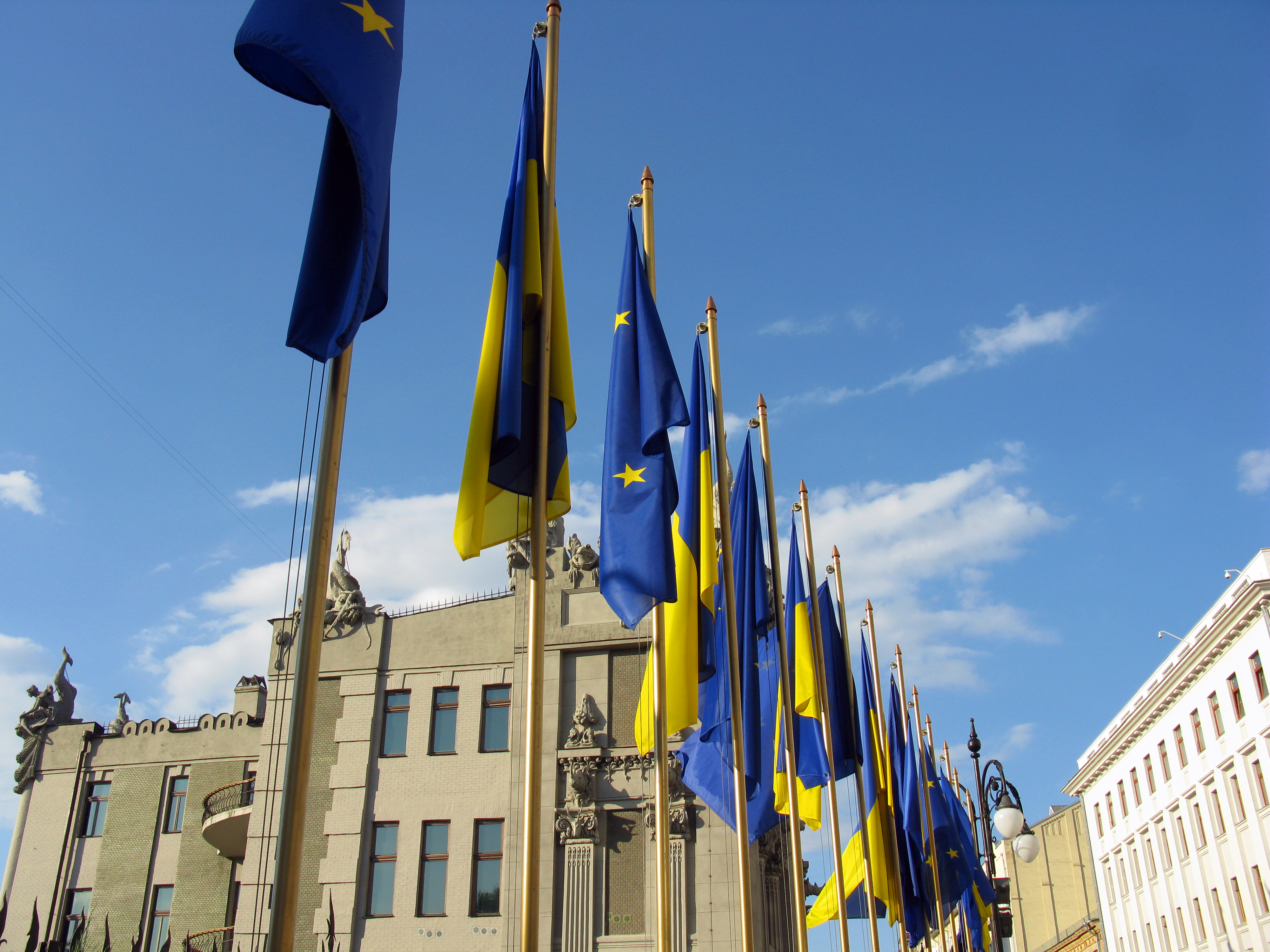
E.U. and Ukrainian flags in Kiev, 2008


About a hundred victims of the Maidan later, only superficially “all is quiet on the Eastern front”. The EU has won a Pyrrhic victory in having a pro-Western government in power in Kiev and the treaty signed. Why Pyrrhic? Because the country is virtually bankrupt and, despite the regime change, remains split. As Russia is likely to break all economic and financial ties to and support of the Kiev government, the EU has to foot the bill of its - in the current (financial) state it is in, megalomaniac - expansion drive. Brussels, and NATO, are part of the power game and to blame for their black-and-white, undiplomatic, role in the conflict. 

Yet, European politicians have only condemned Russia's, admittedly aggressive, brash and imperial, realpolitik, and military and political behaviour with regard to the annexation of Crimea. But they remain nauseously tranquil with regard to their own mistakes in the escalation of the conflict and, more importantly, uncritical towards Western imperialism, i.e. neo-conservative and imperial behaviour of the U.S. intelligence agencies and military - if they are not even in open support of it, as e.g. the government of the United Kingdom is. The U.S. strategy of dividing Europe (the EU) and Russia has borne fruit. Especially the German-Russian relations, who could be described as cooperative, if not amicable, about a decade ago (when Vladimir Putin spoke, mostly in German, in the Bundestag in 2001), lie in complete tatters, as Chancellor Angela Merkel (CDU) and her foreign minister, Frank-Walter Steinmeier (SPD), chose to unequivocally side with Washington.
Vladimir Putin addressing the Bundestag, Berlin on September 25, 2001, mostly in German

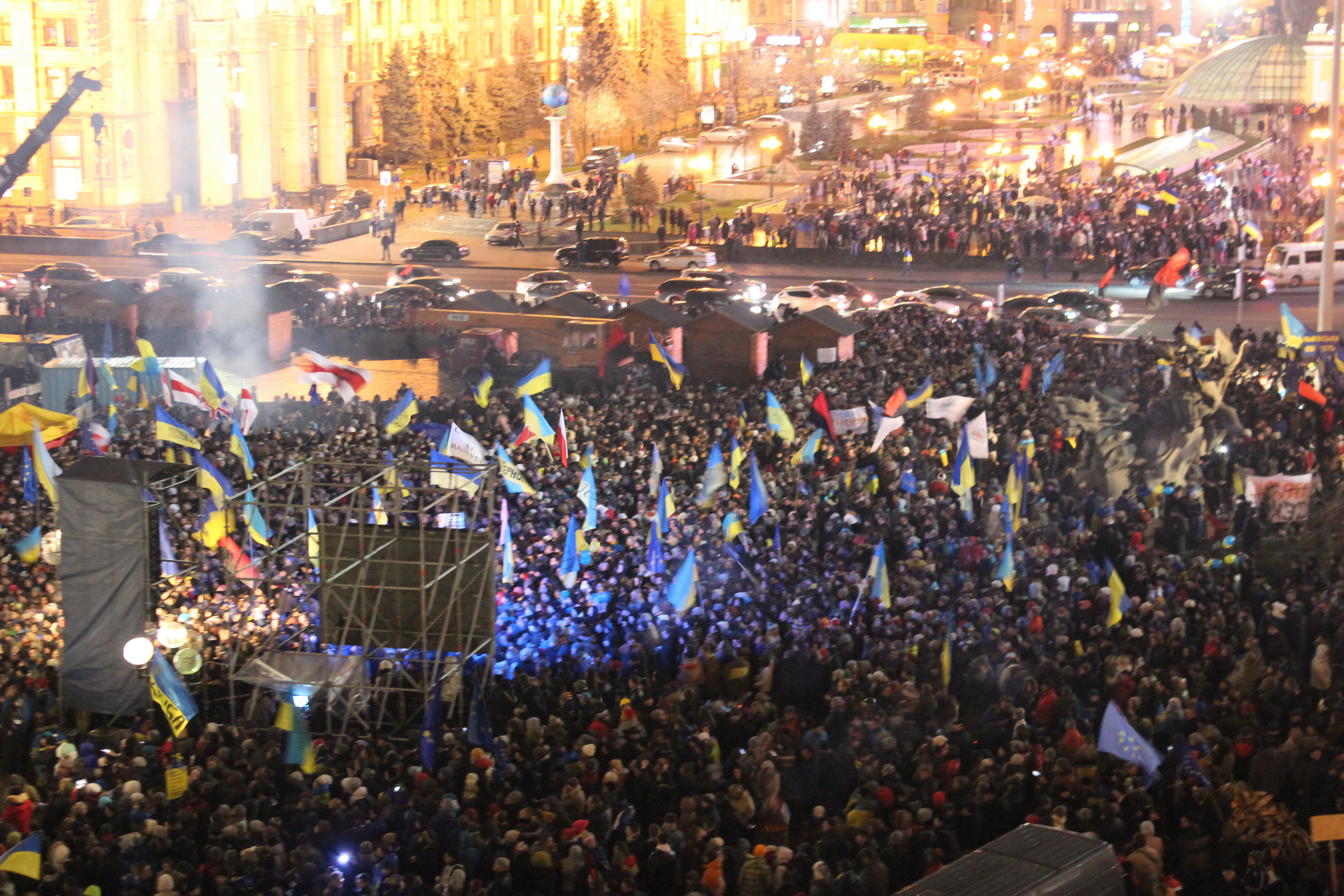
Almost exactly four months ago, on November 21, 2013, the protests soon known as „Maidan“ or „Euromaidan“ started when thousands of people, some primarily out of anger at Victor Yanukovich's government for its oligarchic character, some primarily out of their pro-Western or pro-EU stance, and some out of anti-Russian nationalism, rallied on the Independence Square (Maidan Nezaleshnosti) in the Ukrainian capital Kiev. Nine years after a previous series of protests in 2004 in Ukraine, dubbed Orange Revolution, those protests were triggered by the refusal of then-President Viktor Yanukovich to sign an association agreement with the European Union. The protests, directed not only against the pro-Russian policies of Yanukovich, but also against the economic plight of the country, continued for three months, well into the new year, 2014, until an escalation into more severe violence took place, and subsequently, triggered by that escalation, a revolutionary upheaval shook the political foundations of the country, torn between East and West. Right-wing extremists increasingly took over the Maidan, who had consisted of people of mixed allegiances previously. The first fatalities came on February 18 and the following days: about 100 people were killed in clashes between police and protesters, or by snipers (whose affiliation, first believed to be pro-goverment, has recently become less clear). International diplomacy, that had been rather inactive until then, finally tried to solve the conflict; the foreign ministers of France, Germany and Poland brokered a deal, including a snap presidential election, between the Yanukovich government and opposition leaders, which they agreed upon on February 21. However, the more radical elements from the right wing, who had hijacked the leadership of Maidan, didn't accept the deal and ousted the president in a coup, only a day later, on February 22. The newly-formed government that was set up consists of moderate (neo-)liberals, but also of right-wing extremists of the anti-Russian „Svoboda“ party. The protected status of Russian as a minority language was scrapped, angering the pro-Russian or ethnically Russian population in Eastern Ukraine and on the Crimea Peninsula, giving Russia a pretense to get involved not only politically, but militarily.

The host country of the Sochi Winter Olympics in early and mid-February that were overshadowed by the escalation in Kiev, saw its geopolitical interests, i.e. its ecomomic hegemony in Ukraine and the continued existence of its naval base in Sevastopol in Crimea, endangered by the anti-Russian coup in Kiev, and, almost immediately after the Games were over, moved to take the peninsula, largely (70%) populated by ethnic Russians, (back) into its territory, in late February and early March, in a parallel operation of military invasion and political annexation. Russia was welcomed by an autonomous, anti-Maidan government that had taken over power on Crimea. A referendum set up after the de-facto invasion overwhelmingly supported Russia's move, “bringing back Crimea to its mother country”.

The same way Yanukovich had been ousted by force, despite the diplomatic agreement reached just hours before, and a parliament “formally“ voting him out under the pressure of armed neo-Nazi Right Sector thugs, the Crimean population “formally“ voted under the barrel of Russian or pro-Russian soldiers' guns to join the Russian Federation. Two acts of force, that were backed by “legal“ legitimatory acts after the fact.


EU High Representative Catherine Ashton, U.S. Secretary of State John Kerry, and French foreign secretary Laurent Fabius in Paris, March 5, 2014

But how was this reported and assessed by most European and U.S. politicians and in some (or most) media (with a few exceptions, especially on the Left)? Unbelievably one-sided - apparently “some are more equal than others”. U.S. Foreign Secretary John Kerry made a laughing stock out of himself by uttering in all seriousness, with a completely straight face: ”You just don’t in the 21st century behave in 19th century fashion by invading another country on completely trumped up pretext”. To repeat, this was meant in a serious way. The U.S. must know about this, because when it comes to invading other countries on dubious grounds and without broad international support, they certainly know their stuff, most recently in the Iraq War at the beginning of the 21st century that Kerry mentioned. Destabilizing countries and regions, specifically those who are not “market-friendly” yet, is the favourite hobby of neo-cons like Victoria Nuland, the assistant foreign secretary of State "for Europe and Eurasian affairs", who gained prominence in Europe for saying “fuck the EU”, uttering in a Freudian slip, the U.S. attitude towards Brussels' “foreign policy” in Ukraine and elsewhere, namely that it should not exist independently of U.S. interests.

Whereas Putin is no doubt an authoritarian, undemocratic president, not far short of a dictator, the new Ukrainian government, that the EU just signed the association agreement with, is a government in which right-wing extremists of the Svoboda party run crucial ministries, such as defense; Svoboda's leader, Oleh Tyahnybok, has openly invoked hatred against Russians, Jews and Germans. Neo-fascist or at least right-wing extremist parties are also in power in countries that are already EU members, most prominently in Hungary, and have been in the past, e.g. in Austria from 2000 to 2008. Bulgarian pr
esident Rossen Plevnelyev (of the GERB party, a conservative party, member of the European People's Party fraction in Brussels, i.e. affiliated with Merkel's CDU), apparently a parrot of Germany and Austria (and dependent on their economic clout within the EU) and a fan of NATO, had the nerve to dismiss the fact that right-wing extremist nationalists are in power in Kiev as “Russian propaganda” echoed by “controlled” media allegedly “bought by Gazprom”, in a talk on the “prospects of Southeastern Europe from the perspective of Bulgaria”, at Vienna's Diplomatic Academy on Friday (as if Western media was not “controlled” at all). He pointed out the breach of the Budapest Memorandum on Security, signed between the U.S., the U.K., Russia and the Ukraine in 1994, by Russia's “Crimvasion”, but e.g. failed to mention that his country had supported the Iraq War, that was doubtful in its legality, to put it mildly, in 2003. He also failed to mention that the association agreement is basically a dictate by the IMF and the World Bank, to impose a neo-liberal agenda and austerity on Ukraine with no commitment on future membership of Ukraine (or at least lifting visa restrictions for Ukrainians) on the part of EU, in return for “economic and financial aid” by these actors, and that people on Crimea, now Russians (at least from Moscow's point of view), enjoy higher salaries and pensions than they would under the Kiev government.


02.12.2013

Ukraine between the EU and Russia: The "EwroMaidan" protests as the precursor to a second “Orange Revolution”?

The pro-EU (Ukrainian: "Ewromaidan", Євромайдан) protests in Ukraine have been going on for ten days now, culminating on Sunday with at least 100 000 people on the streets in Kiev. As with many other recent protests before, they are not mainly single-cause protests, but also aiming at more general systemic issues, such as corruption, a mismanaged economy (with doubtful prospects for the young generation) and other underlying, endemic problems of the Post-Soviet era. Yet they were triggered in their intensity and dynamics by a single (albeit significant) event; this event (or "non-event") was the refusal by the Kiev government to sign an association treaty, that would have linked Ukraine closer to the European Union, at a meeting with EU governments and ministers in Lithuania this week (a recent article on the EU, the treaty and the Vilnius meeting (in German) can be found here). The protests are a manifestation of political will in the struggle between Brussels and Moscow, with the former in possession of the (so far only) "soft power" and the latter of the "hard power".


Pro-EU ("EwroMaidan") protests in Kiev (29-11-13). Майдан Незалежності ("Maidan Nezaleshnosti"), "Independence Square", in Kiev is the center of the largest protests in Ukraine since the days of the "Orange Revolution" in November/December 2004 


Russia had successfully put pressure on Kiev to refrain from such a major pro-European step. The accession to the Brussels-led European confederacy, that Ukraine is (was?) striving for for more than  five years now, is the hope of many of the younger generation, especially those who are highly qualified and see their future prospects fulfilled better in the West, or in a Ukraine as part of the EU, rather than in a "Soviet-style" (i.e. unequal) partnership with Moscow. Ukrainian President Viktor Yanukovitch is facing economic pressure from Moscow, i.e. the muscle that Vladimir Putin's Russia is flexing to avoid Kiev's signature of any pro-EU treaties on the one hand, and the mass demonstrations, on the weekend increasingly escalating into open revolt, against his decision to delay the signature of the treaty on the other. The protests, whose focus is in Kiev as well as in the Western Ukrainian cities of Lviv and Ivano-Frankivsk, culminated on Saturday, when riot police (i.e. the special forces, “Berkut”,) used clubs and tear gas, injuring 35 protesters, to disperse a mainly student crowd on Kiev's Independence Square, Ukrainian: Майдан Незалежності/Maidan Nezaleschnosti, the square that gives the protests their name ("EwroMaidan").

As with the other major wave of protests in Eastern Europe and elsewhere, e.g. the ones that have been going on for almost a year now in Bulgaria, the pro-EU “EwroMaidan” protest movement is mainly carried and supported by younger people, mainly students; lectures were suspended in the universities at Lviv, Ivano-Frankisk and Uzchorod. The supporters are of the same, mainly Catholic, pro-European, Western Ukrainian clientele than the ones who opposed Yanukovitch already exactly that time of year nine years ago, in 2004, when an election, that turned out to be rigged in favour of Yanukovitch, triggered what became known as the “Orange Revolution”; it subsequently brought pro-Western candidate Viktor Yuschchenko into office after the run-off election between Yanukovitch and Yuchtchenko was repeated on December 26, with Yuschchenko the winner.

Nine years ago, though, it was more of a national conflict, with EU accession far from consideration, whereas now it is a regional or international one, characterized by the open and direct influence of Brussels, but of course even more so, of Moscow, on the politics of Ukraine. Also, in the same manner, the protesters are probably more "international" or internationally oriented, and thus more comparable to the younger generation of protesters of the new "Occupy" or "indignado" generation in North America and (Southern) Europe that came into being as a result of the financial and economic crisis of the last half-decade; the young Ukrainians probably have more in common with them (and especially with those in the other formerly Communist countries Bulgaria and Romania protesting recently)  than with many Ukrainians of the older generation.


After the Orange revolution, the Eastern European country remained culturally and politically split between the pro-European and the pro-Russian faction (the Yanukovitch camp, of Orthodox confession and often Russian-speaking). Yanukovitch became Prime Minister, replacing Yulia Timoshenko, from 2006 to 2007, when he in turn, as the result of snap elections, was replaced by Timoshenko. The 2010 presidential elections went Yanukovitch's way again, when he defeated Timoshenko; she was controversially sentenced to a prison term a year later. 


09.10.2013

The tragedy of Lampedusa, the expansion of „Fortress Europe“ and the strengthening of right-wing populists: commitment to humanism and solidarity or a renaissance of nationalist populism?

The fate of Africa and of the refugees coming from there is still as embarrassing to supposedly “Christian“ and “humanistic“ Europe as ever.


"Boat people" from Africa in the Mediterranean Sea


Last week, another “refugee disaster happened“ off the coast of the Italian Mediterranean island of Lampedusa. As usual when African refugees drown or get stranded in the Mediterranean on their way to Europe, the event was called a “disaster” and “crisis,” as if it was an inevitable disaster caused by forces of nature that fatefully reached Lampedusa (and Europe).


In reality, the problem is a social and humanitarian one, which cannot be solved simply by sandbags or state force, such as (in this case the EU border) police („Frontex“). But instead of searching for real solutions, the EU has exacerbated its policy of a harsh approach towards these refugees and has militarized Frontex, whose task it is to control, protect and monitor the EU's external borders. The root causes of these waves of refugees – the abject poverty and the large socio-economic gap between the richer regions of the North and the West and the poorer ones of the South and the East - are usually not talked about in the mainstream media coverage or are just covered by niche channels, that are not conducive to the bulk of the public (such as a report on “Fortress Europe“ by German-French channel arte on Tuesday, October 8th, 22.10, that can be re-viewed here: http://www.arte.tv/de/760670.html, in German or French).

On the main public squares of some European cities and in the editorial offices of the tabloid media outlets, the retreat into nationalistic patterns is demanded and encouraged, according to which local populations should again be the first and foremost point of reference for politics, with “foreigners” less welcomed and attended to. The fears and old xenophobic instincts are instigated, of “the stranger“, who is presented as bad and dangerous to the interest of the local people, by populists, from Oslo to Berlin to Vienna and elsewhere. National shells appear comfortable and offer protection from “the foreign people, a-fighting, down in Turkey, far away“, as German poet J. W. Goethe wrote in his drama “Faust“ (1808) in the scene “Before the city-gate“:

“On Sundays, holidays, there’s naught I take delight in,
Like gossiping of war, and war’s array,
When down in Turkey, far away,
The foreign people are a-fighting.
One at the window sits, with glass and friends,
And sees all sorts of ships go down the river gliding:
And blesses then, as home he wends
At night, our times of peace abiding.“

This is said by “another citizen“ in a conversation among citizens.

This was more than two-hundred years ago. Now, in the twenty-first century, things are slightly different. Today, due to the cultural and above all economic globalization there is no (or almost no) point of the world left that could be compared to Goethe's “far away in Turkey“ then. The regions of the world are, for better or for worse, intrinsically linked to each other, economically and as far as the modes of communications and transport are concerned. In the seventeenth and eighteenth century, the powers of Europe expanded and thus created the first global economic network, a kind of “world system“, as Immanuel Wallerstein characterized it. In this age, later called “imperialism“, the “centres“ of the world system, i.e. the colonial powers (first Portugal, Spain, the Netherlands, then Britain and France, to be followed by Belgium, Italy and the German Empire) profited from the “periphery“, i.e. the colonies (initially in America, then in Asia and, well into the twentieth century, in Africa), or in other words exploited them.

In the twentieth century, by means of economic “globalization“, hailed as a mantra by neoliberal economists and politicians, this system of direct exploitation was replaced by one of indirect exploitation. Although the colonies were given their independence and political self-determination, they were still dominated by the West's ratio of economic exploitation. European and North American workers were deemed “too expensive“ in the “rationalization“ calculations of the multi-national corporations and others, their jobs outsourced, with a “race to the bottom“ taking place with regard to the costs of labour. Many goods consumed in the West were and are produced in the former colonies under conditions of exploitation. Social standards that apply in the Western working place are not only ignored there; far worse, conditions are inhumane, and in fact, human lives are often deemed worthless by the powers that be when the pursuit of their prestige of profit is concerned. The most recent, sad examples of this are the deaths of dozens of construction workers of the stadia that are being built for the 2022 FIFA football World Cup in Qatar, or the hundreds of factory workers who suffered a cruel death in the collapse of a textiles factory in Bangladesh. Meanwhile, the (comparatively) rich petty bourgeois in the West apparently stands at the window and secretly takes delight in this or at least doesn't care much about the fate of the people there, “in Turkey, far away“, and keeps celebrating hedonistically “on Sundays, holidays“ at fun fairs (“Oktoberfest“) or elsewhere.

The apathy and indifference of many people in the West is almost as bad as the hatred and the small-mindedness of the racists and xenophobes, who not only hate the foreigners, but see them as a threat to their standard of living, that is based on the exploitation of exactly the same people in the (formerly so-called) “Third World“. This attitude of “strangers as a threat“ is widely held by many in the North, not only towards the non-European asylum seekers or economic migrants, but increasingly also towards the supposedly “lazy Southerners“ in Europe, who allegedly effortlessly receive money from the Northerners “as a gift“. This is perhaps the biggest myth, not to say most blatant lie, that the “Springer“ (i.e. “yellow“) press and other media outlets have hammered into many Germans' perceptions (and that has probably brought a lot of extra votes to Chancellor Merkel): that the German taxpayer has “saved Greece“. In reality, the banks and financial speculators have made a killing in these “rescue“ operations, whereas the populations of those “crisis“ countries, from Athens to Dublin, have suffered severe cuts; thus, it has been a redistribution of money from the lower and middle classes to the very top. “People around here [Germany and the other rich Northern countries] squat on their comparatively gigantic wealth and are frightening themselves almost to death – as if the future has not always been uncertain“, Austrian writer Eva Menasse aptly described those in the populace, who fell for the scare tactics of the populists or right-wing extremists (such as the „Progress Party“ (Norway), Orbán and “Jobbik“ (Hungary), Strache, Stronach (Austria), Wilders (Netherlands), the anti-EU “Alternative für Deutschland“ and parts of the Conservative party (CDU/CSU) in Germany) and their henchmen in the press (Germany's “BILD“ paper and Austria's “Kronen-Zeitung“, and many national TV stations). This fear has been brought into the main stream of the European societies and the tendency towards more cosmopolitanism, which seemingly began to grow with the process of Europeanization, has been killed off by austerity and right-wing populism.