
The pro-EU (Ukrainian: "Ewromaidan", Євромайдан) protests in Ukraine have been going on for ten days now, culminating on Sunday with at least 100 000 people on the streets in Kiev. As with many other recent protests before, they are not mainly single-cause protests, but also aiming at more general systemic issues, such as corruption, a mismanaged economy (with doubtful prospects for the young generation) and other underlying, endemic problems of the Post-Soviet era. Yet they were triggered in their intensity and dynamics by a single (albeit significant) event; this event (or "non-event") was the refusal by the Kiev government to sign an association treaty, that would have linked Ukraine closer to the European Union, at a meeting with EU governments and ministers in Lithuania this week (a recent article on the EU, the treaty and the Vilnius meeting (in German) can be found here). The protests are a manifestation of political will in the struggle between Brussels and Moscow, with the former in possession of the (so far only) "soft power" and the latter of the "hard power".
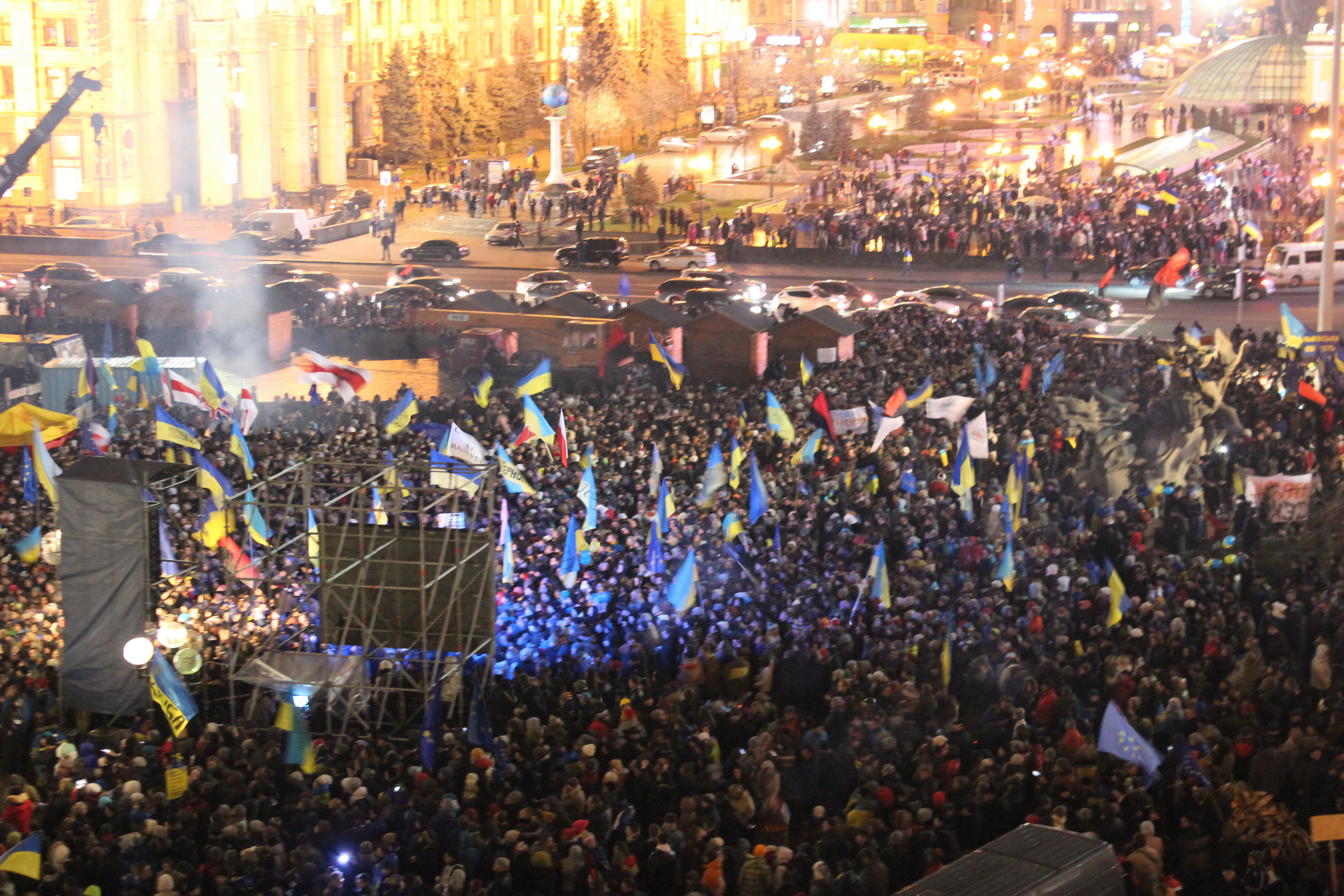
Pro-EU ("EwroMaidan") protests in Kiev (29-11-13). Майдан Незалежності ("Maidan Nezaleshnosti"), "Independence Square", in Kiev is the center of the largest protests in Ukraine since the days of the "Orange Revolution" in November/December 2004
Russia had successfully put pressure on Kiev to refrain from such a major pro-European step. The accession to the Brussels-led European confederacy, that Ukraine is (was?) striving for for more than five years now, is the hope of many of the younger generation, especially those who are highly qualified and see their future prospects fulfilled better in the West, or in a Ukraine as part of the EU, rather than in a "Soviet-style" (i.e. unequal) partnership with Moscow. Ukrainian President Viktor Yanukovitch is facing economic pressure from Moscow, i.e. the muscle that Vladimir Putin's Russia is flexing to avoid Kiev's signature of any pro-EU treaties on the one hand, and the mass demonstrations, on the weekend increasingly escalating into open revolt, against his decision to delay the signature of the treaty on the other. The protests, whose focus is in Kiev as well as in the Western Ukrainian cities of Lviv and Ivano-Frankivsk, culminated on Saturday, when riot police (i.e. the special forces, “Berkut”,) used clubs and tear gas, injuring 35 protesters, to disperse a mainly student crowd on Kiev's Independence Square, Ukrainian: Майдан Незалежності/Maidan Nezaleschnosti, the square that gives the protests their name ("EwroMaidan").
As with the other major wave of protests in Eastern Europe and elsewhere, e.g. the ones that have been going on for almost a year now in Bulgaria, the pro-EU “EwroMaidan” protest movement is mainly carried and supported by younger people, mainly students; lectures were suspended in the universities at Lviv, Ivano-Frankisk and Uzchorod. The supporters are of the same, mainly Catholic, pro-European, Western Ukrainian clientele than the ones who opposed Yanukovitch already exactly that time of year nine years ago, in 2004, when an election, that turned out to be rigged in favour of Yanukovitch, triggered what became known as the “Orange Revolution”; it subsequently brought pro-Western candidate Viktor Yuschchenko into office after the run-off election between Yanukovitch and Yuchtchenko was repeated on December 26, with Yuschchenko the winner.
Nine years ago, though, it was more of a national conflict, with EU accession far from consideration, whereas now it is a regional or international one, characterized by the open and direct influence of Brussels, but of course even more so, of Moscow, on the politics of Ukraine. Also, in the same manner, the protesters are probably more "international" or internationally oriented, and thus more comparable to the younger generation of protesters of the new "Occupy" or "indignado" generation in North America and (Southern) Europe that came into being as a result of the financial and economic crisis of the last half-decade; the young Ukrainians probably have more in common with them (and especially with those in the other formerly Communist countries Bulgaria and Romania protesting recently) than with many Ukrainians of the older generation.
After the Orange revolution, the Eastern European country remained culturally and politically split between the pro-European and the pro-Russian faction (the Yanukovitch camp, of Orthodox confession and often Russian-speaking). Yanukovitch became Prime Minister, replacing Yulia Timoshenko, from 2006 to 2007, when he in turn, as the result of snap elections, was replaced by Timoshenko. The 2010 presidential elections went Yanukovitch's way again, when he defeated Timoshenko; she was controversially sentenced to a prison term a year later.
