Posts mit dem Label Kerry werden angezeigt. Alle Posts anzeigen

20.01.2017

From Russia with love? The end of the Obama era, the new Cold War and the globalist “Querfront”

Some media reports in Germany have purported the (recent and not-so-recent) existence of a “common front of the extreme left and the extreme right” - in German Querfront, literally “across front - that allegedly “works together” against “democracy”, the EU, “free” markets (e.g. free trade agreements such as CETA, TTIP or TPP), “liberal capitalism”, multiculturalism, feminism and LGBT rights.


They are alleging a cooperation between fascists or nationalists, who are against multiculturalism, feminism, LGBT rights and cultural globalism, on the one hand, and socialists, critical of capitalism, “corporatocracy, “free” trade, and economic globalism, on the other. Yet only because they address some similar issues and are critical of similar uncritical liberal pro-globalist propaganda doesn't mean that they are “populists” (currently the favourite buzzword to delegitimize anyone who is critical), and that they all share the same interests.

Outgoing Secretary of State Kerry with New York Times Columnist Thomas Friedman
(a self-described "radical centrist")  at the World Economic Forum in Davos, the main
globalist networking forum for business, finance, media and politics, on January 17, 2017


Yet the real 
Querfront has emerged in the “bourgeois middle” against this alleged “extremist” Querfront, at least in foreign policy and most economic policies, and it reaches from centre-left Social Democrats (e.g. those in the EU parliament) in Europe, the Democrats in the US (e.g. the Clintons) and centrist civil rights liberals ”quer” across the political spectre to centre-right economic neo-liberals (those who are currently meeting in Davos to plot the new globalist strategy); it also includes the traditionally conservative anti-communist “cold warriors”, as well as the new hawkish neo-conservatives in the tradition of Donald Rumsfeld and Paul Wolfowitz.


As the day of the inauguration of Donald Trump is upon us, the situation calls for a new global peace congress, yet tensions are set to rise in a new Cold War between three powers – the US (with its willing or (more or less) recalcitrant allies in Europe and the Middle East), Russia and China. Europe is (at least as the unity its core professes to aspires to) economically and politically shattered. And, with a few positive exceptions, the media and politics on both sides of the Atlantic are bogged in a propaganda war of mutual finger-pointing, instead of promoting a pragmatic rather than an ideological analysis. The crisis in (at least) four areas (communications, ecology, socio-economics, politics) is reminiscent of the mid- to late 1920s and early 1930s, the new, escalating confrontation between NATO, Russia and China on the other, with talk of renewed nuclear rearmament (!!), of the early 1960s. Confrontations in Eastern Europe and the South China Sea are becoming more likely, as NATO and the US are ramping up their presence there.

It has always been very convenient for conservative politicians to blame “outsiders” or “the other side” (during and ever since the Cold War), and many of them have defined themselves against it (e.g. anti-communists or il-liberals). Most recently, since the escalation between the West and Russia (and increasingly also China) within the last decade or so, alleged or actual “foreign meddling” (in Ukraine 2014, in the US presidential election 2016) has been used to legitimise and support sanctions on Russia on the one hand (more damaging for Europe than for the US, whose trade with Russia is minimal) and to distract from the endemic failure of the system they have been promoting and perpetuating, on the other. It is also supposed to distract from their own (mostly US) “meddling” (to put it mildly) into other countries' affairs, too - Argentina, Georgia, Guatemala, Haiti, Honduras, Iraq, Libya, Mali, Russia, Serbia, Ukraine, Venezuela, and this is only from the past fifteen years or so, the for more details research the history of the CIA, or go to Wikileaks.


Most recently though, in a strange, almost paradoxical twist of events, these traditional anti-communist or anti-liberal warriors have been joined by their (former?) opponents on the other side, i.e. many liberals (the Querfront mentioned above). Many centre-left or centrist Clinton and Obama supporters have in recent years thrown any self-reflection overboard in their analysis of this failure, and have (in the “Russian hack” matter) even gone as far as sheepishly taking reports of shady organisations such as the CIA on face value (despite their brilliant Iraq WMD “evidence”?). No one doubts that there was some degree of Russian influence, yet by blowing it out of proportion and making it the biggest US “news” story in weeks, and going as far as ejecting Russian diplomats from the US, the White House is actually strengthening Russia's position, by giving it more PR than it deserves and by indirectly echoing the Kremlin's talking points. Vladimir Putin couldn't be happier about this, as he is the only one coming out stronger than ever before.


23.03.2014

“All quiet on the Eastern Front” and “some are more equal than others”? The assocation agreement, the Ukraine, Russia, the EU and the U.S. after “EwroMaidan” and “Crimvasion”

The signature of the association agreement between the de-facto new Ukrainian government of Arseny Yatsenyuk in Kiev and the EU last Friday, four months after the beginning of the protests, is not the end of the Maidan story and certainly not the end of the conflict in the country and the whole Eastern European region. Western hypocrisy and double standards towards Russia with regard to Maidan and Crimea have estranged Moscow not only further from London and Washington, but now increasingly from Brussels and Berlin as well.


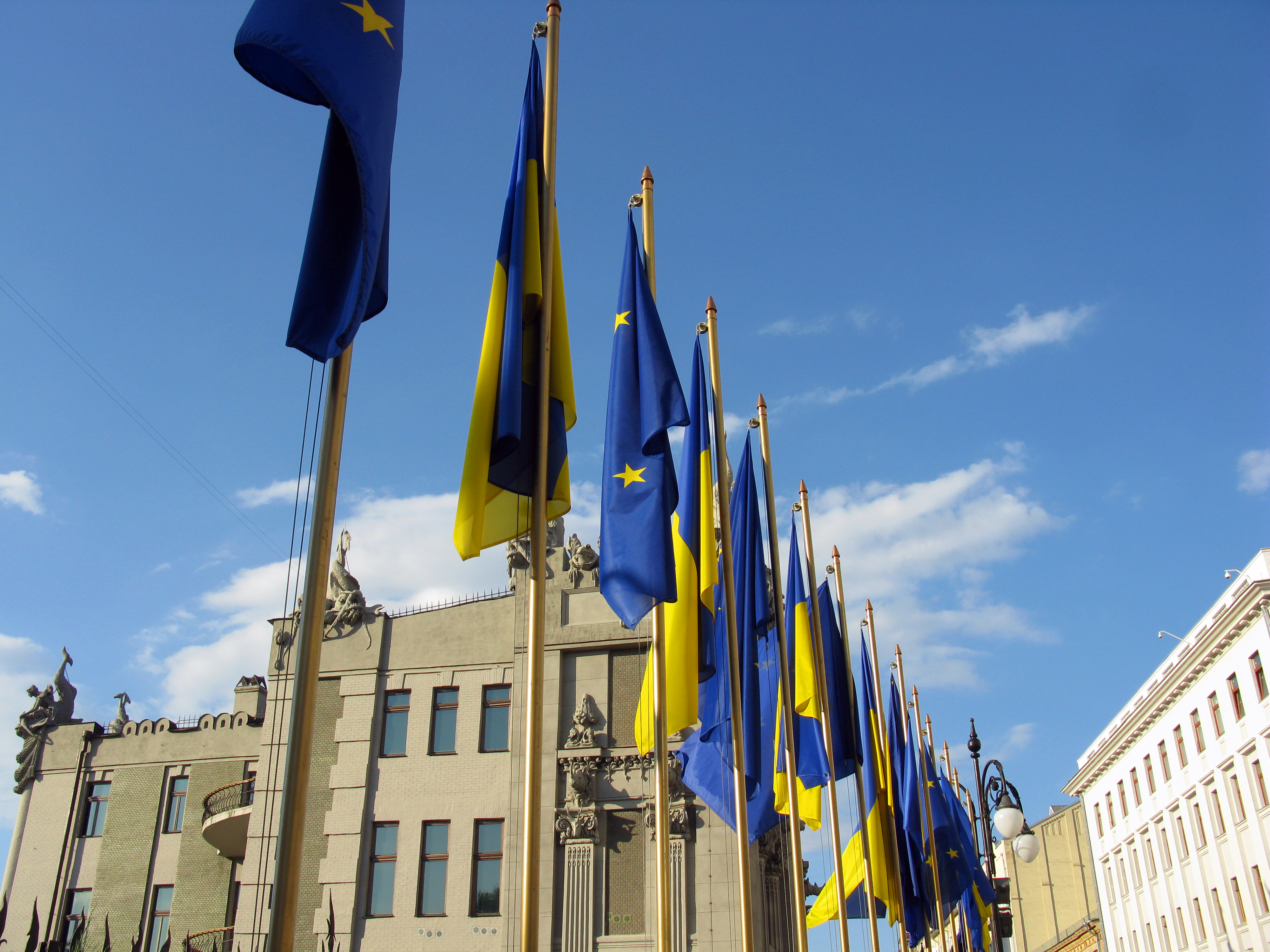
E.U. and Ukrainian flags in Kiev, 2008


About a hundred victims of the Maidan later, only superficially “all is quiet on the Eastern front”. The EU has won a Pyrrhic victory in having a pro-Western government in power in Kiev and the treaty signed. Why Pyrrhic? Because the country is virtually bankrupt and, despite the regime change, remains split. As Russia is likely to break all economic and financial ties to and support of the Kiev government, the EU has to foot the bill of its - in the current (financial) state it is in, megalomaniac - expansion drive. Brussels, and NATO, are part of the power game and to blame for their black-and-white, undiplomatic, role in the conflict. 

Yet, European politicians have only condemned Russia's, admittedly aggressive, brash and imperial, realpolitik, and military and political behaviour with regard to the annexation of Crimea. But they remain nauseously tranquil with regard to their own mistakes in the escalation of the conflict and, more importantly, uncritical towards Western imperialism, i.e. neo-conservative and imperial behaviour of the U.S. intelligence agencies and military - if they are not even in open support of it, as e.g. the government of the United Kingdom is. The U.S. strategy of dividing Europe (the EU) and Russia has borne fruit. Especially the German-Russian relations, who could be described as cooperative, if not amicable, about a decade ago (when Vladimir Putin spoke, mostly in German, in the Bundestag in 2001), lie in complete tatters, as Chancellor Angela Merkel (CDU) and her foreign minister, Frank-Walter Steinmeier (SPD), chose to unequivocally side with Washington.
Vladimir Putin addressing the Bundestag, Berlin on September 25, 2001, mostly in German

Almost exactly four months ago, on November 21, 2013, the protests soon known as „Maidan“ or „Euromaidan“ started when thousands of people, some primarily out of anger at Victor Yanukovich's government for its oligarchic character, some primarily out of their pro-Western or pro-EU stance, and some out of anti-Russian nationalism, rallied on the Independence Square (Maidan Nezaleshnosti) in the Ukrainian capital Kiev. Nine years after a previous series of protests in 2004 in Ukraine, dubbed Orange Revolution, those protests were triggered by the refusal of then-President Viktor Yanukovich to sign an association agreement with the European Union. The protests, directed not only against the pro-Russian policies of Yanukovich, but also against the economic plight of the country, continued for three months, well into the new year, 2014, until an escalation into more severe violence took place, and subsequently, triggered by that escalation, a revolutionary upheaval shook the political foundations of the country, torn between East and West. Right-wing extremists increasingly took over the Maidan, who had consisted of people of mixed allegiances previously. The first fatalities came on February 18 and the following days: about 100 people were killed in clashes between police and protesters, or by snipers (whose affiliation, first believed to be pro-goverment, has recently become less clear). International diplomacy, that had been rather inactive until then, finally tried to solve the conflict; the foreign ministers of France, Germany and Poland brokered a deal, including a snap presidential election, between the Yanukovich government and opposition leaders, which they agreed upon on February 21. However, the more radical elements from the right wing, who had hijacked the leadership of Maidan, didn't accept the deal and ousted the president in a coup, only a day later, on February 22. The newly-formed government that was set up consists of moderate (neo-)liberals, but also of right-wing extremists of the anti-Russian „Svoboda“ party. The protected status of Russian as a minority language was scrapped, angering the pro-Russian or ethnically Russian population in Eastern Ukraine and on the Crimea Peninsula, giving Russia a pretense to get involved not only politically, but militarily.

The host country of the Sochi Winter Olympics in early and mid-February that were overshadowed by the escalation in Kiev, saw its geopolitical interests, i.e. its ecomomic hegemony in Ukraine and the continued existence of its naval base in Sevastopol in Crimea, endangered by the anti-Russian coup in Kiev, and, almost immediately after the Games were over, moved to take the peninsula, largely (70%) populated by ethnic Russians, (back) into its territory, in late February and early March, in a parallel operation of military invasion and political annexation. Russia was welcomed by an autonomous, anti-Maidan government that had taken over power on Crimea. A referendum set up after the de-facto invasion overwhelmingly supported Russia's move, “bringing back Crimea to its mother country”.

The same way Yanukovich had been ousted by force, despite the diplomatic agreement reached just hours before, and a parliament “formally“ voting him out under the pressure of armed neo-Nazi Right Sector thugs, the Crimean population “formally“ voted under the barrel of Russian or pro-Russian soldiers' guns to join the Russian Federation. Two acts of force, that were backed by “legal“ legitimatory acts after the fact.


EU High Representative Catherine Ashton, U.S. Secretary of State John Kerry, and French foreign secretary Laurent Fabius in Paris, March 5, 2014

But how was this reported and assessed by most European and U.S. politicians and in some (or most) media (with a few exceptions, especially on the Left)? Unbelievably one-sided - apparently “some are more equal than others”. U.S. Foreign Secretary John Kerry made a laughing stock out of himself by uttering in all seriousness, with a completely straight face: ”You just don’t in the 21st century behave in 19th century fashion by invading another country on completely trumped up pretext”. To repeat, this was meant in a serious way. The U.S. must know about this, because when it comes to invading other countries on dubious grounds and without broad international support, they certainly know their stuff, most recently in the Iraq War at the beginning of the 21st century that Kerry mentioned. Destabilizing countries and regions, specifically those who are not “market-friendly” yet, is the favourite hobby of neo-cons like Victoria Nuland, the assistant foreign secretary of State "for Europe and Eurasian affairs", who gained prominence in Europe for saying “fuck the EU”, uttering in a Freudian slip, the U.S. attitude towards Brussels' “foreign policy” in Ukraine and elsewhere, namely that it should not exist independently of U.S. interests.

Whereas Putin is no doubt an authoritarian, undemocratic president, not far short of a dictator, the new Ukrainian government, that the EU just signed the association agreement with, is a government in which right-wing extremists of the Svoboda party run crucial ministries, such as defense; Svoboda's leader, Oleh Tyahnybok, has openly invoked hatred against Russians, Jews and Germans. Neo-fascist or at least right-wing extremist parties are also in power in countries that are already EU members, most prominently in Hungary, and have been in the past, e.g. in Austria from 2000 to 2008. Bulgarian pr
esident Rossen Plevnelyev (of the GERB party, a conservative party, member of the European People's Party fraction in Brussels, i.e. affiliated with Merkel's CDU), apparently a parrot of Germany and Austria (and dependent on their economic clout within the EU) and a fan of NATO, had the nerve to dismiss the fact that right-wing extremist nationalists are in power in Kiev as “Russian propaganda” echoed by “controlled” media allegedly “bought by Gazprom”, in a talk on the “prospects of Southeastern Europe from the perspective of Bulgaria”, at Vienna's Diplomatic Academy on Friday (as if Western media was not “controlled” at all). He pointed out the breach of the Budapest Memorandum on Security, signed between the U.S., the U.K., Russia and the Ukraine in 1994, by Russia's “Crimvasion”, but e.g. failed to mention that his country had supported the Iraq War, that was doubtful in its legality, to put it mildly, in 2003. He also failed to mention that the association agreement is basically a dictate by the IMF and the World Bank, to impose a neo-liberal agenda and austerity on Ukraine with no commitment on future membership of Ukraine (or at least lifting visa restrictions for Ukrainians) on the part of EU, in return for “economic and financial aid” by these actors, and that people on Crimea, now Russians (at least from Moscow's point of view), enjoy higher salaries and pensions than they would under the Kiev government.